SwitchChallenge tips: how to solve transformation puzzles with less guesswork
Looking for SwitchChallenge tips usually means you already noticed the core difficulty: it is easy to follow one appealing pattern and ignore a better logical mapping. SwitchChallenge is inspired by operator-based reasoning tasks where you transform one sequence into another. The best approach is systematic: decode the transformation process in steps, then test candidates in a controlled order.
This guide gives you a practical method you can use in every session. Keep SwitchChallenge practice open while reading and apply each section directly.
Created by GapChallenge, a free practice site for deductive reasoning puzzles inspired by Aon-style assessments.
Procter & Gamble (P&G) hiring processes are one reason many candidates search directly for SwitchChallenge and DigitChallenge preparation. This guide is built for that intent: practical steps you can apply immediately under timed conditions.
What SwitchChallenge measures
SwitchChallenge measures your ability to track symbol movement and infer which operator sequence explains that movement correctly. In easy mode, you compare one transformation. In hard mode, you often handle an intermediate step before evaluating final options. This tests more than pattern spotting. It tests working memory, sequencing discipline, and error detection.
The skill overlaps with other deductive formats, but the mechanism is different from grid elimination in GapChallenge. Here, order matters heavily. A correct operator in the wrong position can still produce the wrong result.
How operator logic works
An operator describes where each item should move. Think of it as a mapping instruction from the original sequence to a new sequence. To solve reliably, convert each candidate operator into an explicit movement test. Do not rely on visual impression alone.
- Write or mentally mark the starting positions.
- Apply one candidate operator step by step.
- Compare the produced sequence with the target sequence.
- Reject immediately when one position fails.
This approach dramatically reduces wasted time. Instead of debating which option “looks right,” you verify which option is logically exact.
A systematic way to solve sequence transformations
Use a two-phase routine. Phase one: quick elimination. Scan all options and remove candidates that fail obvious position checks. Phase two: deep verification. Run the full mapping on the remaining one or two candidates.
In hard mode, include the intermediate sequence as a separate checkpoint. Treat it as a real transformation stage, not a hint. Many errors come from mentally jumping straight from top row to bottom row and forgetting to apply the middle step correctly.
A strong habit is to verbalize internally: “position one goes to X, position two goes to Y.” This anchors your reasoning and prevents accidental swaps when the timer is active.
Example solving mindset: pick one operator candidate, run the mapping from source to target in order, and stop at the first mismatch. This gives you a fast yes/no decision instead of partial confidence.
Worked transformation examples
Use this quick layout whenever you review a screenshot: write the top sequence with position numbers, apply one candidate operator, and compare the output directly with the bottom sequence.
Example A (step-by-step candidate testing)
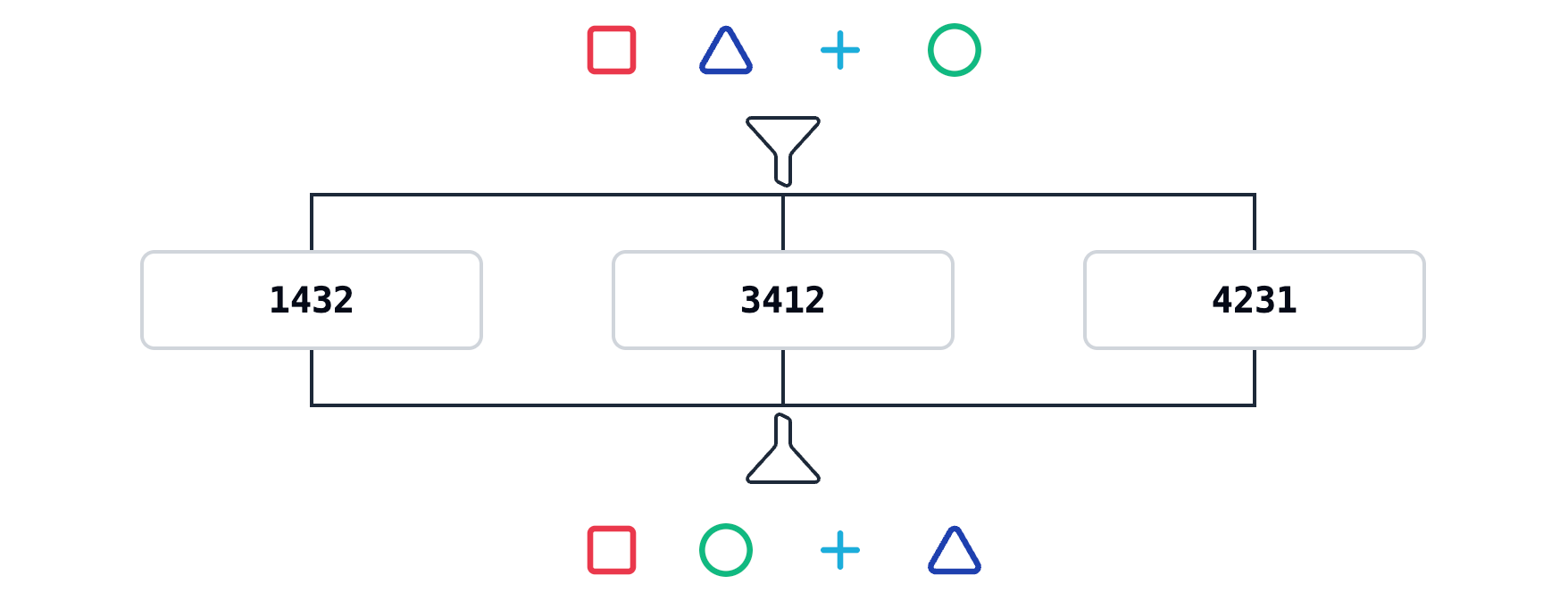
Screenshot example: top symbols, candidate options, and target bottom sequence.
Top: 1=square, 2=triangle, 3=plus, 4=circle
Target bottom: square, circle, plus, triangle
Candidates shown: 1432, 3412, 4231.
- Start with one candidate, for example 1432.
- Interpret it as “take positions 1, then 4, then 3, then 2” from the top row.
- This gives: square, circle, plus, triangle.
- Compare with the target bottom sequence position by position.
- If all four positions match, keep it. If one position fails, reject and test the next candidate.
Solve this screenshot now:
- Write the top row as numbered positions (`1,2,3,4`).
- Apply each candidate in order: first `1432`, then `3412`, then `4231`.
- After each try, compare all four output positions to the bottom row.
- Stop as soon as one candidate matches all four positions exactly.
Self-check: in this screenshot, 1432 is the valid operator.
Example B (hard mode: intermediate-step reasoning)
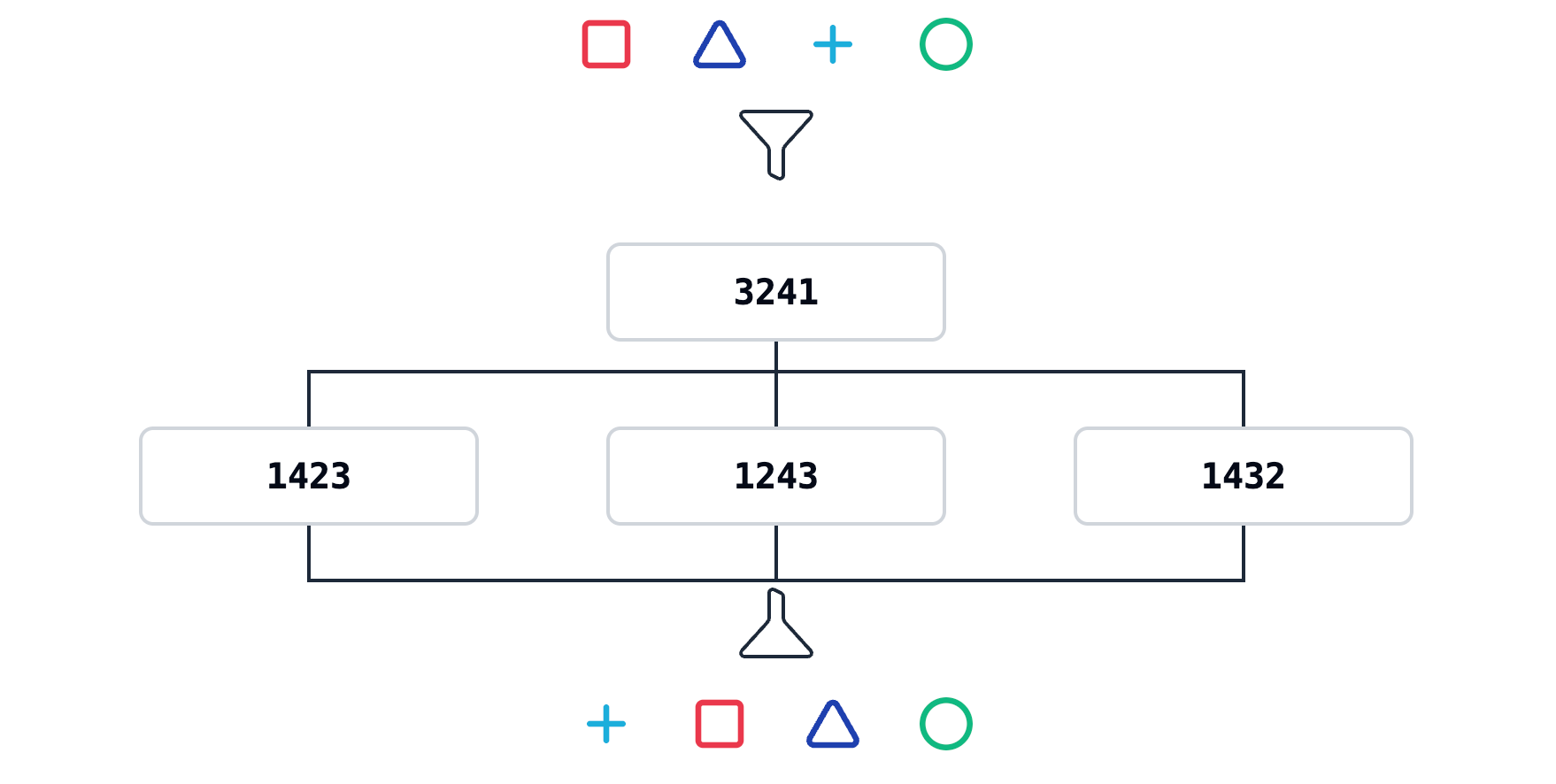
Screenshot example: apply the intermediate operator first, then test candidate operators.
Top: 1=square, 2=triangle, 3=plus, 4=circle
Intermediate operator: 3241
After 3241: plus, triangle, circle, square
Target bottom: plus, square, triangle, circle
Candidates: 1423, 1243, 1432
- Start from the intermediate sequence (`plus, triangle, circle, square`), not the original top row.
- Test 1423: take positions 1, 4, 2, 3 from the intermediate row.
- This gives: plus, square, triangle, circle.
- That exactly matches the target bottom sequence, so this candidate is valid.
Solve this screenshot now:
- Apply the intermediate operator `3241` to the top row first.
- Using that intermediate output, test `1423`, `1243`, and `1432` in order.
- Reject immediately on first mismatch with the bottom row.
- Keep the candidate that matches all four positions.
Self-check: in this screenshot, 1423 is the valid final operator.
Common mistakes in SwitchChallenge
The first common mistake is partial matching. A candidate that fixes three positions but breaks one is still wrong. The second mistake is direction confusion: applying mapping from target to source instead of source to target. The third is speed collapse under pressure, where players skip verification after finding a “likely” option.
Another frequent issue is cognitive overload in hard mode. If you lose track mid-sequence, restart from the beginning with one candidate instead of trying to patch memory gaps. Clean re-evaluation is faster than uncertain continuation.
How to practice for speed and accuracy
Train in blocks. Start with short easy-mode rounds to reinforce mapping accuracy. Then add hard-mode rounds to build intermediate-step control. Track two metrics: percentage correct and average completion time. Optimize for stable accuracy first, then reduce time.
You can also alternate with GapChallenge strategy practice to keep your deductive process sharp across different puzzle styles. This prevents tunnel vision and improves general reasoning flexibility.
If your goal is assessment readiness, consistency beats intensity. Daily focused practice with a fixed method produces better long-term performance than occasional marathon sessions.
Related guides: