How to pass digitChallenge: practical strategy for a five-minute adaptive test
digitChallenge is a five-minute adaptive arithmetic test used in hiring assessments. Candidates fill missing digits in equations while respecting arithmetic order and the rule that each digit can only appear once.
This guide explains a practical solving strategy and shows worked examples so you can practice the format before the test. You can practice this solving method directly in the DigitChallenge puzzle.
Created by GapChallenge, a free practice site for deductive reasoning puzzles inspired by Aon-style assessments.
Procter & Gamble (P&G) hiring processes are one reason many candidates search for DigitChallenge and SwitchChallenge practice. Use this guide as a focused preparation framework and combine it with timed rounds in the live puzzle.
digitChallenge rules
- Fill missing digits in an equation.
- Digits 1–9 can only be used once per equation.
- Follow arithmetic order (BODMAS).
- Complete the equation correctly.
Repeatable solving method
- Read the structure first (operators and brackets).
- Estimate the target range.
- Try larger digits first when multiplication is present.
- Apply BODMAS before submitting.
- Verify no digit is reused.
This routine keeps you accurate under pressure and reduces rework.
How to solve quickly in a five-minute window
Set mini time limits per item. If an equation is not close to solved after one clean pass, reset your attempt and pick a new candidate combination. In adaptive tests, preserving accuracy is better than forcing one hard item too long.
Keep your mental order fixed: brackets first, multiplication next, then addition/subtraction. Most wrong answers in digitChallenge come from doing arithmetic in the wrong order rather than choosing impossible digits.
Common mistakes
- Ignoring bracket priority in mixed equations.
- Reusing a digit already placed in another slot.
- Submitting before checking all operators in order.
- Spending too long on one hard item and losing volume.
Worked equation examples
Use these two screenshots as practice drills. The point is not memorizing one answer, but learning the solving sequence you can repeat in timed rounds.
Example A (easy format): ? + ? - ? = 11
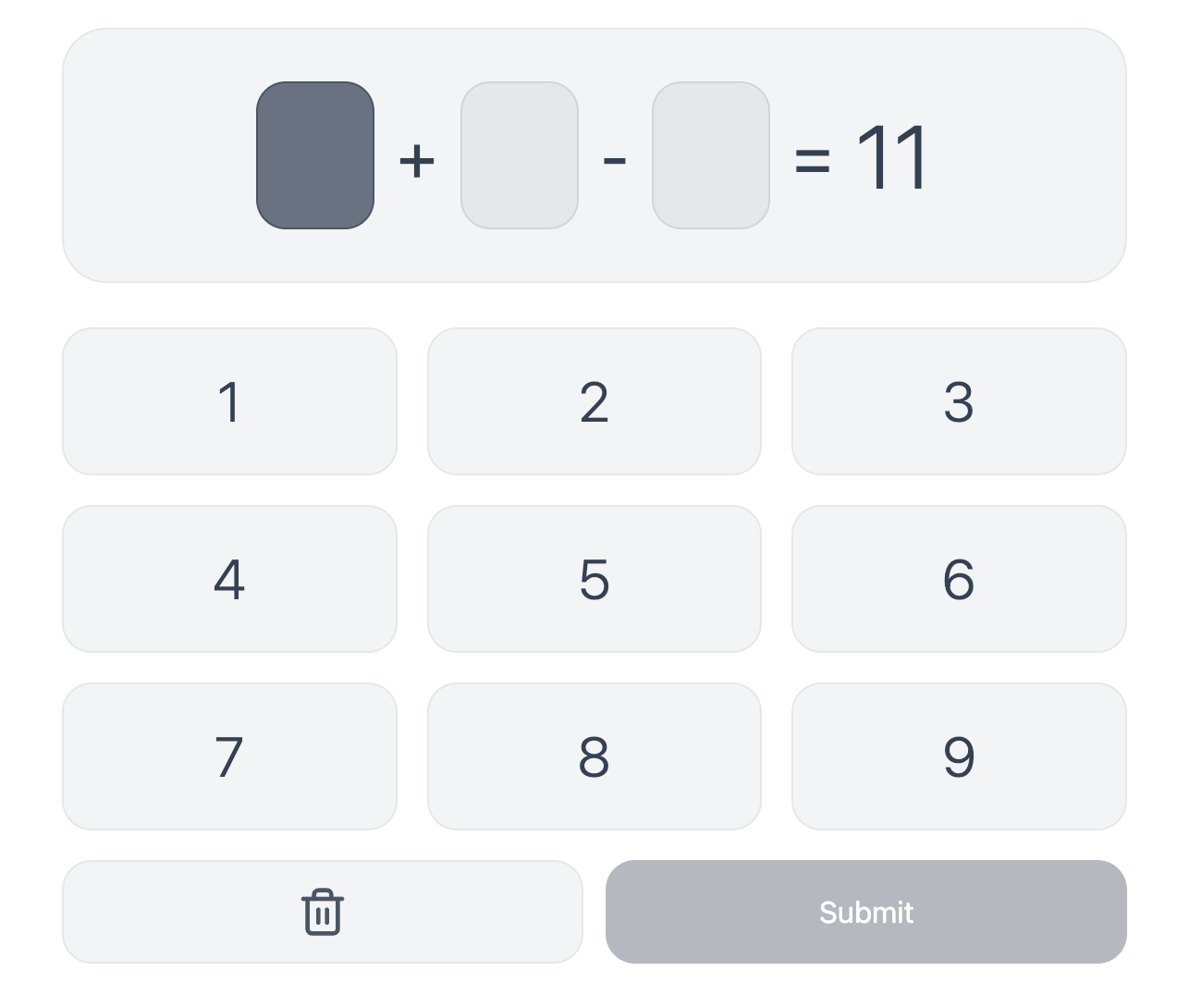
Screenshot example: three slots with addition/subtraction and target 11.
- Start from the structure: one addition and one subtraction, so think in terms of a + b then remove c.
- Pick a plausible sum first (for example 14, 15, or 16), then choose a subtraction digit to land on 11.
- Check digit uniqueness immediately: the same digit cannot appear twice in this equation.
- Run a quick arithmetic verification before submit.
Solve this screenshot now:
- Try one clean candidate set (for example 8 + 4 - 1).
- Verify it equals 11 and uses unique digits.
- If not valid, swap only one slot at a time and re-check.
Self-check: one valid solution is 8 + 4 - 1 = 11.
Example B (hard format): (? × ?) + (? × ?) = 32
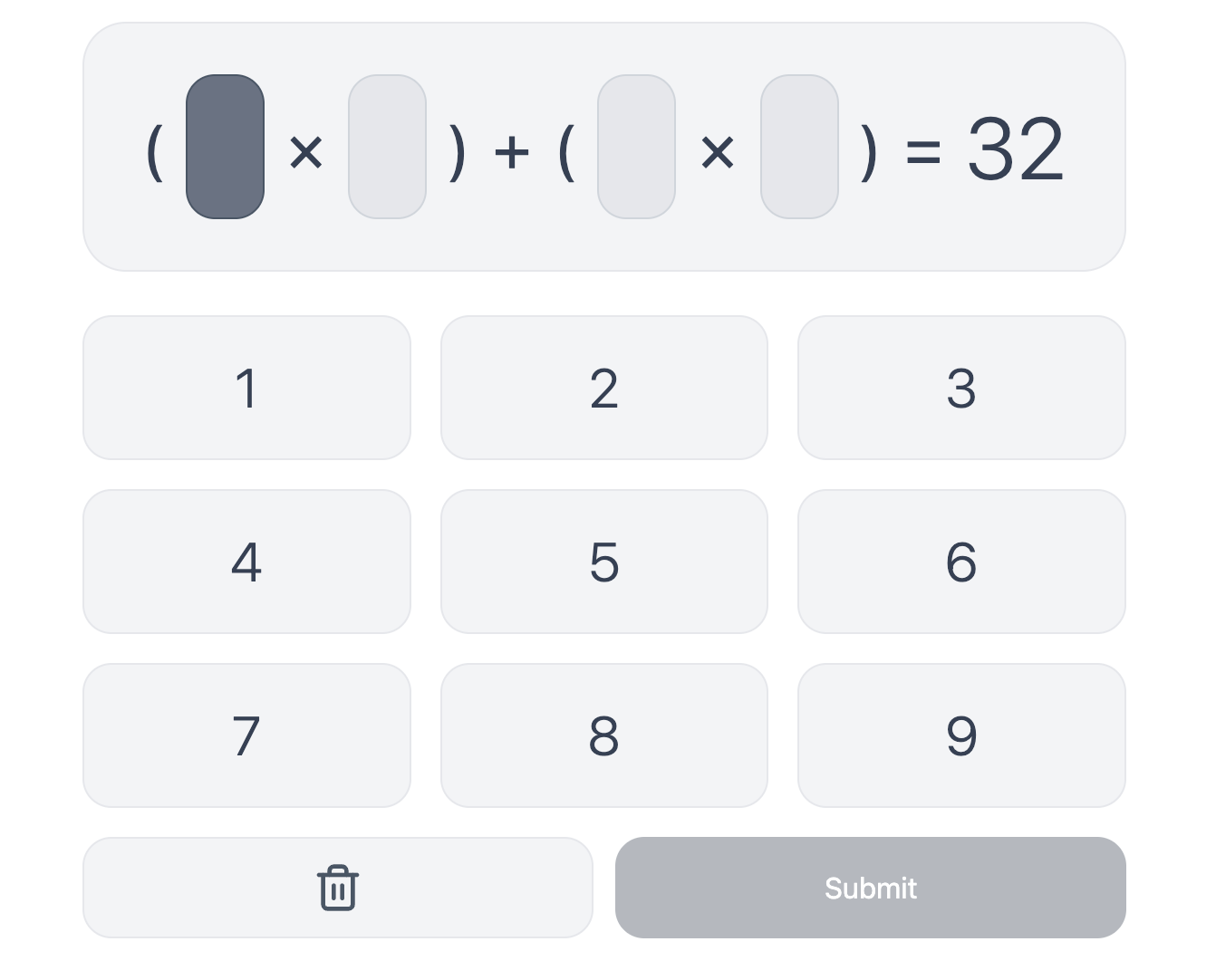
Screenshot example: two multiplication blocks combined by addition.
- Read the structure first: this is a sum of two products, so split the target into two multiplication results.
- Generate product pairs from digits 1-9 that can combine to 32 (for example 12 and 20, or 14 and 18).
- Select two pairs that do not reuse digits across all four slots.
- Check full equation and uniqueness before submit.
Solve this screenshot now:
- Pick a first product pair (for example 3 × 4 = 12).
- Compute the remaining target (32 - 12 = 20).
- Find a second product pair with unused digits. If every pair reuses a digit or misses the target, change your first pair and repeat.
- Continue until both product terms add exactly to 32 with all digits unique.
Self-check: one valid solution is (4 × 5) + (2 × 6) = 32.
Practice plan
- Start with easy puzzles to understand the structure.
- Practice multiplication patterns in hard mode.
- Run full five-minute test simulations.
You can practice this format directly in the DigitChallenge puzzle.
You can combine this with GapChallenge strategy and SwitchChallenge tips to train both numerical and deductive decision-making.
Related guides: