How to pass GapChallenge: practical strategy that actually works
If you are searching for how to pass GapChallenge, the fastest improvement does not come from guessing more often. It comes from using one repeatable process on every puzzle, especially when the timer is running. GapChallenge is inspired by scales lst style thinking tasks, so the same preparation principles apply: reduce uncertainty, eliminate options in a structured way, and avoid rushing into avoidable mistakes.
This guide gives you a clear method you can apply immediately. If you want to start practicing while you read, open GapChallenge practice in a second tab and test each step in real puzzles.
Created by GapChallenge, a free practice site for deductive reasoning puzzles inspired by Aon-style assessments.
Best method in 5 steps
- Scan the question row for used symbols.
- Scan the question column for used symbols.
- Eliminate all used symbols from candidates.
- Check nearby unresolved cells for forced moves.
- Answer only when one candidate remains logically valid.
What the GapChallenge test measures
GapChallenge measures how well you recognize constraints in a grid and use logic to find the only valid missing symbol. In plain terms, each row and each column must contain unique shapes. That single rule creates a web of restrictions. The test is not asking who can memorize tricks. It asks who can work carefully, detect patterns, and stay accurate under pressure.
Strong performance depends on three things: reading the grid correctly, rejecting invalid candidates quickly, and keeping mental control when time is tight. If you already practice other deductive formats such as SwitchChallenge, you will recognize this pattern: the best candidates use structure, not intuition alone.
The elimination strategy
The most reliable elimination strategy is a two-pass scan. In pass one, look at the question cell and list the symbols that are already present in its row and column. Remove those from the candidate set. In pass two, inspect nearby emptier cells that influence the same row or column and ask what they force. This second pass often removes the final wrong option.
- Step 1: Identify all symbols already used in the question row.
- Step 2: Identify all symbols already used in the question column.
- Step 3: Remove overlaps and write down remaining candidates mentally.
- Step 4: Check adjacent unresolved cells for forced placements that narrow candidates further.
- Step 5: Commit only when one candidate remains logically valid.
This method sounds basic, but it prevents random clicking. Most errors happen when players skip step four and assume the puzzle is ready before constraints have fully propagated.
While practicing, use the empty cells as a scratchpad for forced placements. Select a shape and place it temporarily in an unresolved cell, then continue the deduction chain on the board instead of holding every step in memory. Click the same temporary shape again to remove it, or use the eraser to clear all temporary placements before trying another path.
Worked puzzle examples (easy and hard)
Use these screenshot examples as a solving routine. The goal is not to guess the answer from the image directly. The goal is to apply the same repeatable elimination process and prove one symbol is valid.
Example A (easy): row-column elimination first
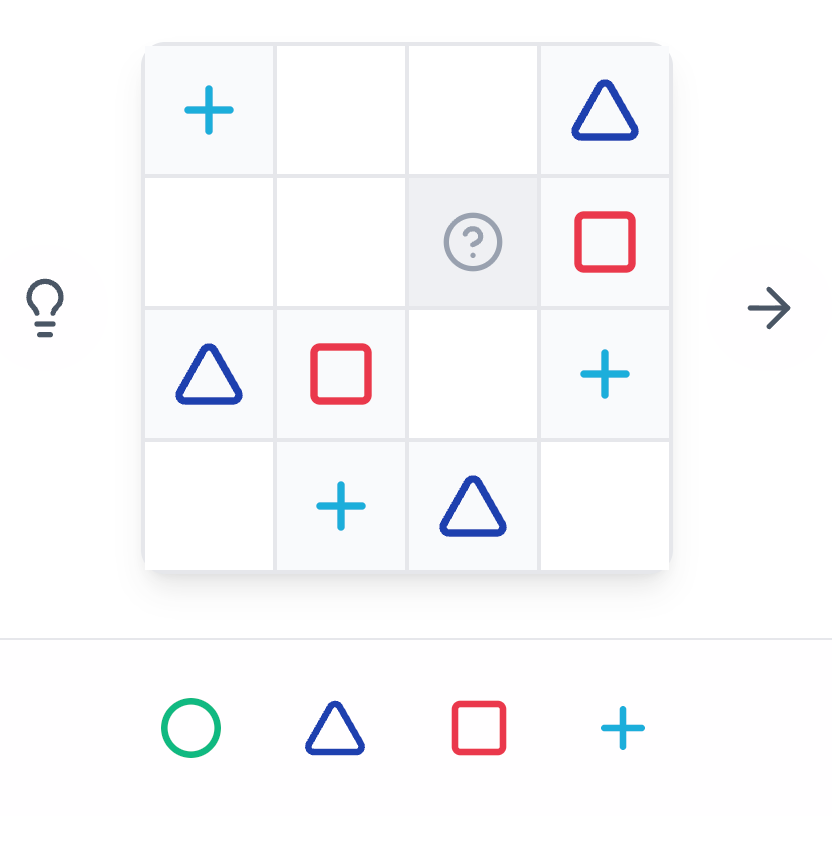
Screenshot example: start with direct row and column constraints around the question cell.
- Question cell is row 2, column 3.
- Row 2 currently has a square at column 4, so row 2 cannot be square.
- Column 3 already has a triangle at row 4, so column 3 cannot be triangle.
- This leaves circle or plus as candidates for row 2, column 3.
- Now check row 2, column 1. Column 1 already has plus (row 1) and triangle (row 3), so row 2, column 1 must be circle.
- That forces row 2 to place triangle at column 2, leaving plus at row 2, column 3.
Easy mode often resolves with one forced-cell chain like this.
Solve this screenshot now:
- Start at row 2, column 3 and reduce to two candidates using row/column bans.
- Find one nearby empty cell in the same row that becomes forced.
- Use that forced value to eliminate the last wrong candidate for the question cell.
- Confirm the final symbol against both row and column rules.
Self-check answer: the correct symbol for this screenshot is plus.
Example B (hard): add second-pass constraint checks
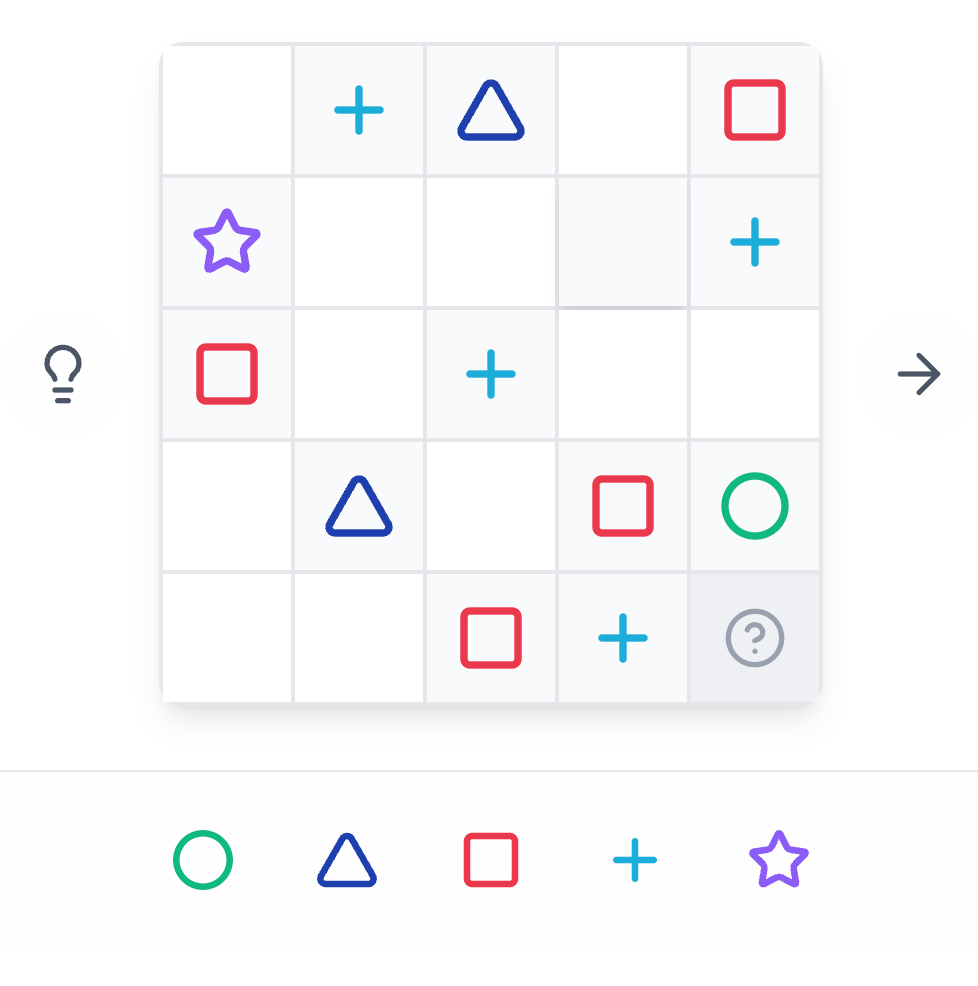
Screenshot example: hard mode usually needs one extra inference beyond direct row-column elimination.
- Question cell is row 5, column 5.
- Column 5 already has square (row 1), plus (row 2), and circle (row 4), so the question is either triangle or star.
- Use forced deductions away from the question: row 2 column 3 becomes circle, then row 2 column 4 becomes triangle, and row 2 column 2 becomes square.
- This forces row 4 column 3 to star, then row 4 column 1 to plus, then row 1 column 1 to circle and row 1 column 4 to star.
- Column 5 now contains square, plus, triangle, circle, and one missing symbol: star.
Hard mode is solved by chained deductions like this, where each forced cell removes ambiguity later.
Solve this screenshot now:
- Narrow the question to two symbols from its row/column constraints.
- Find a different row/column where one symbol is forced.
- Continue chaining forced placements until the question column has only one missing symbol.
- Validate that symbol against the question row as final confirmation.
Self-check answer: the correct symbol for this screenshot is star.
How to work faster under time pressure
Speed comes from consistency, not panic. Start each puzzle with the same scan order. For example, always begin with the row of the question cell, then the column, then the nearest high-information cells. When your eyes follow a fixed route, you reduce re-checking and recover faster from distractions.
Use mini-deadlines inside the timer. Give yourself a short window to narrow candidates, then another short window to confirm the final option. If you exceed that window, restart the scan from the top instead of guessing. This costs a few seconds but saves more by avoiding wrong answers and resets.
Difficulty level matters here. On easy mode, the path is often direct. On medium mode, one extra inference is common. On hard mode, you usually need a chain of deductions. Build speed by mastering the same process on easy and medium first, then add hard once your baseline is stable.
Common mistakes to avoid
The first mistake is guessing too early. A candidate can look plausible but still be invalid once a related cell is solved. The second mistake is scanning only rows or only columns. You need both, every time. The third mistake is forgetting to reset your reasoning after a pause. If attention drops, restart your elimination checklist instead of relying on memory.
Another common problem is over-focusing on one area of the board. Gap puzzles are global constraint problems. A decisive clue may sit outside the immediate neighborhood of the question mark. Train yourself to zoom out periodically and confirm full-grid consistency.
Why repeated practice improves performance
Repetition builds pattern speed. After enough sessions, your brain recognizes common dead ends and promising paths faster. You also become calmer under time limits, which improves accuracy. In assessment conditions, this emotional control can be as important as pure logic.
Practical routine: run short daily sessions, rotate difficulty levels, and track two metrics: completion accuracy and average solve time. If time improves while accuracy stays stable, your process is working. If time improves but accuracy drops, slow down and enforce the elimination checklist again.
Use this guide as your base playbook, then validate it in real puzzles. Consistent execution beats isolated tricks.
If you are preparing for a timed assessment invitation, treat this page as your tactical checklist and use live GapChallenge rounds to build execution speed.